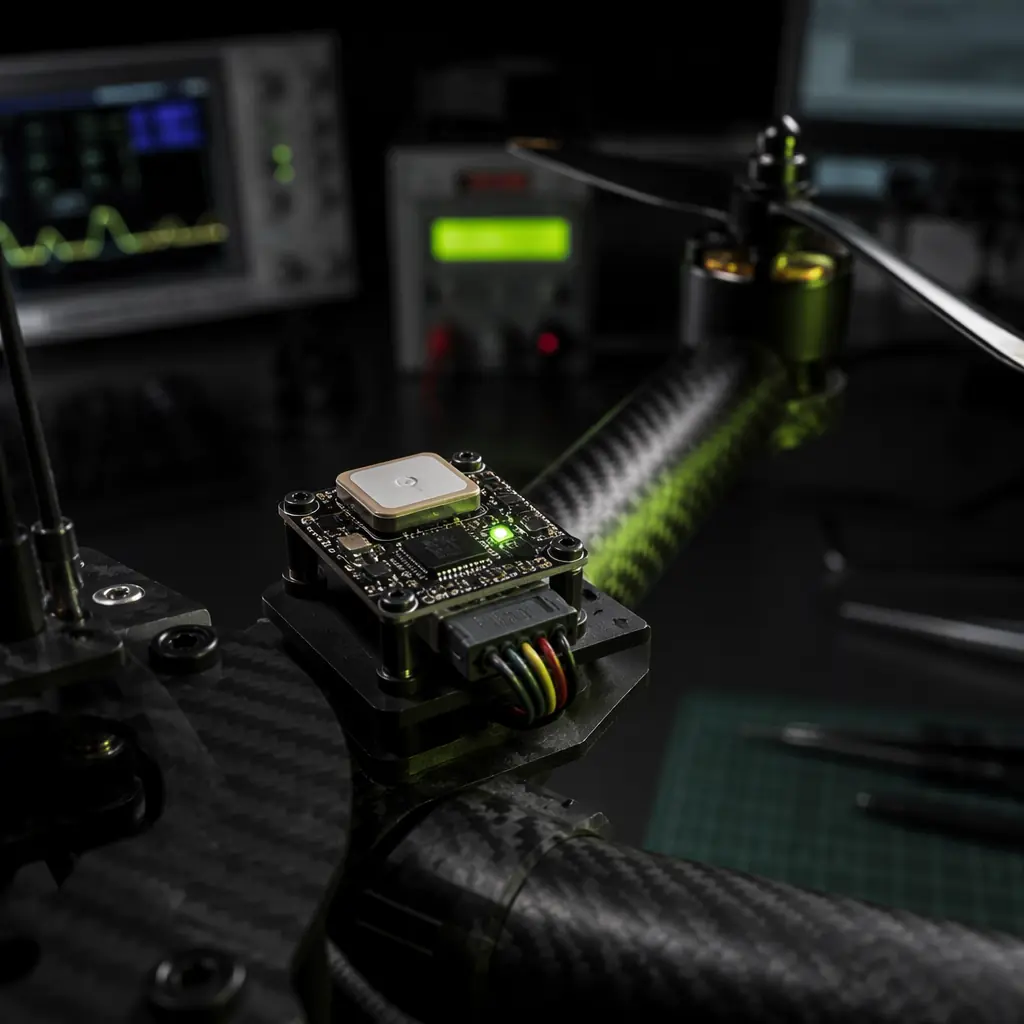
Remote ID is the single regulatory requirement that has most disrupted the UAV component supply chain since the introduction of brushless motor technology. Unlike voluntary standards such as ISO 9001 or market-access certifications such as CE marking — which are important but do not ground an aircraft on their own — Remote ID is a mandatory operational requirement with an active enforcement mechanism. The FAA's Remote ID rule (14 CFR Part 89) requires that any UAV over 250 grams either broadcast its identification, location and control station position via a standardized message format (Standard Remote ID), or be operated within a FAA-Recognized Identification Area (FRIA) where no broadcast is required — and the number of FRIAs is deliberately limited and shrinking. The EASA U-space regulatory framework, which applies to all EU member states and EEA countries, imposes an equivalent requirement through the Direct Remote Identification (DRI) specification defined in Delegated Regulation (EU) 2019/945. Japan, Canada, Australia and Brazil have adopted or are adopting compatible frameworks based on the ASTM F3411 standard for Remote ID message formatting and the ASTM F3586 standard for the broadcast physical layer. The result is that Remote ID is no longer a U.S.-specific compliance concern — it is a global airspace access requirement, and the component supply chain must treat it as such.
This article is structured as a component procurement guide, not a regulatory summary. We cover the hardware modules that implement Remote ID at the physical layer — broadcast modules, network Remote ID endpoints, GPS/GNSS receivers dedicated to the Remote ID function, and the antennas and data buses that connect them to the flight controller — and the integration considerations that determine whether a given module will pass the FAA's Means of Compliance (MoC) declaration or the EASA's DRI conformity assessment. The regulatory framework itself is evolving too rapidly for a static article to serve as legal guidance; for the current regulatory text, consult the FAA's Remote ID page and EASA's U-space page. This article focuses on what the procurement team needs to know to source, integrate and validate Remote ID hardware — the component decisions that will determine whether the UAV passes its compliance audit on the first attempt.
Standard Remote ID broadcast: the hardware architecture under 14 CFR Part 89
Standard Remote ID is the primary compliance pathway for UAVs operating in U.S. airspace outside FRIAs. The broadcast message — transmitted via Bluetooth 4 or 5 (BLE), Wi-Fi NAN (Neighbor Awareness Networking) at 2.4 GHz, or Wi-Fi Beacon at 2.4 GHz — contains the UAV's unique serial number or session ID, latitude, longitude, barometric altitude, geometric altitude, velocity, time mark, emergency status, and the latitude/longitude of the control station or takeoff location. The message is transmitted at a rate of one message per second during all phases of flight from takeoff to landing, and the broadcast must be receivable by personal wireless devices within a range specified by ASTM F3411 (typically 150–400 meters for BLE, depending on the receiver sensitivity and the transmitter power level).
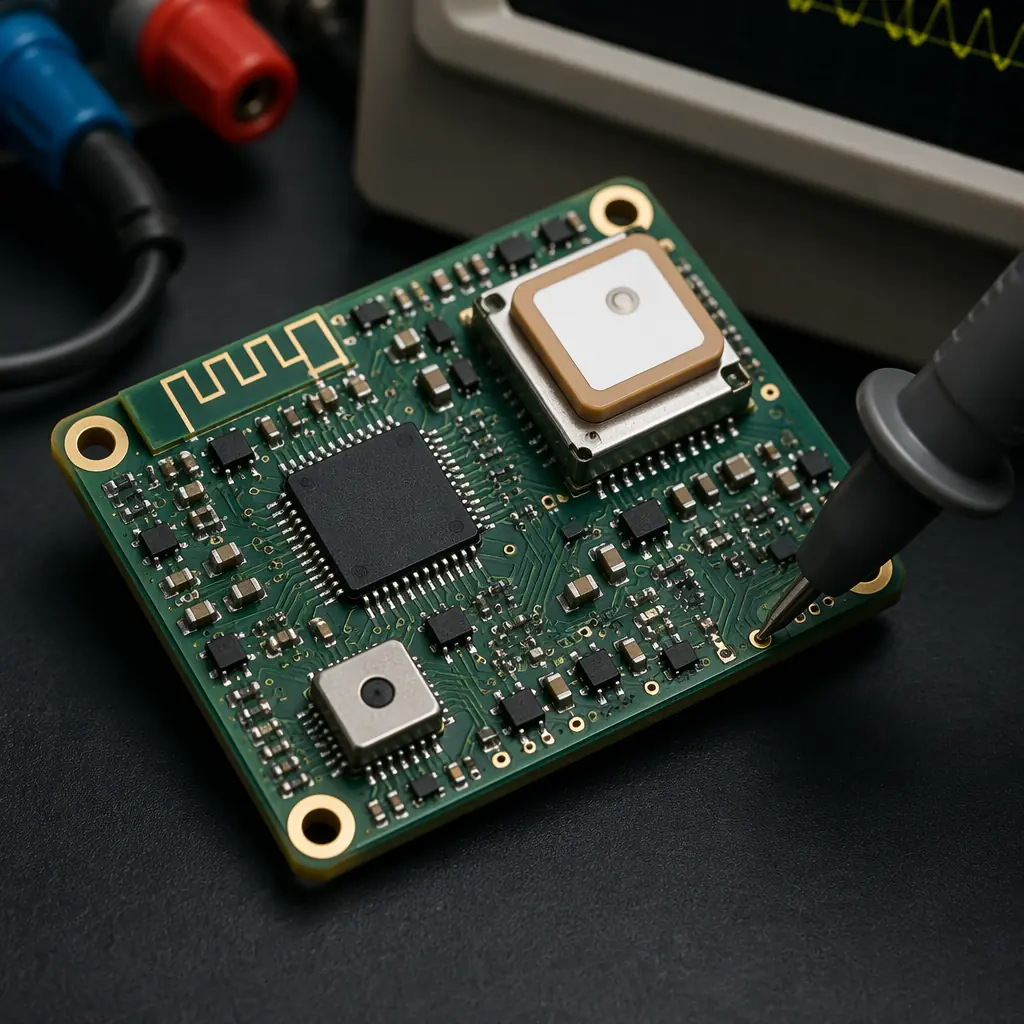
The hardware stack for a Standard Remote ID broadcast module consists of four components, each with procurement implications that are not immediately obvious from the module's datasheet. The BLE or Wi-Fi system-on-chip (SoC) is the broadcast transmitter — typically a Nordic nRF52 or nRF53 series BLE SoC (nRF52840 is the most common, with +8 dBm transmit power and a PCB trace antenna achieving approximately 200–400 meter range in open air at a 1 Mbps BLE PHY), or an Espressif ESP32-C3 or ESP32-S3 for Wi-Fi NAN broadcast (Wi-Fi NAN provides longer range — up to 600–800 meters — at the cost of higher power consumption, approximately 300–500 mW for the Wi-Fi radio vs 50–100 mW for BLE). The GPS/GNSS receiver provides the position and velocity data included in every broadcast message — this is typically a u-blox M10 or M8 series module (M10 provides 25-second cold-start time-to-first-fix, 2-second hot-start, and 1.5 meter CEP horizontal accuracy with SBAS augmentation), which is the most common choice because its NMEA output format is universally supported by Remote ID broadcast module firmware. The barometric pressure sensor provides the barometric altitude data required by the FAA message format — a Bosch BMP390 or equivalent with ±25 Pa relative accuracy (approximately ±2 meters altitude) is sufficient, but the sensor must be calibrated for the UAV's operating altitude range, and the calibration data must be accessible to the Remote ID module's firmware (typically through I²C bus integration, with the sensor mounted on the same PCB as the BLE SoC to minimize the I²C trace length and avoid noise coupling). The antenna — a PCB trace antenna, chip antenna, or external whip antenna — determines the broadcast range and must be impedance-matched to 50 Ω at 2.4 GHz, with a VSWR below 2.0 across the 2.400–2.4835 GHz ISM band.
 Concept illustration
The procurement decision for a Standard Remote ID module turns on three factors that are often overlooked in the rush to achieve compliance. First: the module's FAA Declaration of Compliance (DoC). Every Remote ID broadcast module sold in the U.S. market must be declared compliant by the manufacturer with an FAA-accepted Means of Compliance (MoC) — typically ASTM F3411-22a for the message format and ASTM F3586-22 for the physical layer. A module without a DoC is not lawful to operate under Standard Remote ID, regardless of its technical specifications. The procurement team must verify that the DoC is current (the FAA's list of accepted DoCs is public and updated quarterly) and that the module's firmware version matches the DoC — a firmware update that changes the message format, the transmission interval or the GPS integration can invalidate the DoC and require re-declaration. Second: the module's integration interface with the flight controller. Most Remote ID modules communicate with the flight controller via UART at 115,200 bps using the MAVLink protocol (the REMOTE_ID message defined in the MAVLink common message set, message ID #283) or via the DroneCAN protocol (the uavcan.equipment.remote_id message, data type ID 20033) on a CAN bus. The flight controller must support the selected protocol and must be configured to forward the UAV's dynamic data (latitude, longitude, altitude, velocity, emergency status) to the Remote ID module at the required 1 Hz rate. If the flight controller's firmware does not include the Remote ID message handler — as is the case with many older PX4 and ArduPilot builds that predate the Remote ID requirement — a firmware upgrade or a dedicated interface bridge (a small microcontroller that reads the GPS and barometer data directly and feeds it to the Remote ID module) is required. Third: the module's power budget. A BLE-based Remote ID broadcast module draws 50–150 mA at 3.3 V or 5 V, which is approximately 0.15–0.50 watts — a negligible load on a UAV's power system compared to the propulsion stack (400–2,000 watts) or the payload (10–50 watts). But the module must remain powered throughout the flight, including during brownout conditions when the flight controller resets — if the Remote ID module loses power mid-flight and stops broadcasting, the UAV is technically non-compliant for the remainder of the mission. Powering the Remote ID module from a dedicated LDO regulator with a 100 µF bulk capacitor on its input — sufficient to ride through a 200-millisecond brownout — is a simple and effective safeguard.
Network Remote ID: the 4G/LTE compliance pathway for BVLOS operations
Network Remote ID is an alternative compliance pathway that transmits the Remote ID message through an internet connection — typically a 4G/LTE cellular modem on the UAV — rather than through a direct broadcast from the aircraft. The message reaches the FAA's Remote ID USS (UAS Service Supplier) network, which makes it available to authorized recipients through an API. Network Remote ID is mandatory for UAVs that cannot carry a Standard Remote ID broadcast module — either because of weight constraints (the module adds 5–15 grams, which may push a sub-250-gram UAV over the limit in some configurations) or because of radio frequency interference with the UAV's primary communication link (BLE at 2.4 GHz can interfere with Wi-Fi-based video downlinks operating in the same band). But the primary advantage of Network Remote ID is that it enables Beyond Visual Line of Sight (BVLOS) operations — the broadcast message travels through the cellular network, which covers a far larger area than the 150–400 meter BLE broadcast radius, and the USS network can provide the Remote ID data to any authorized recipient anywhere in the world through the internet.
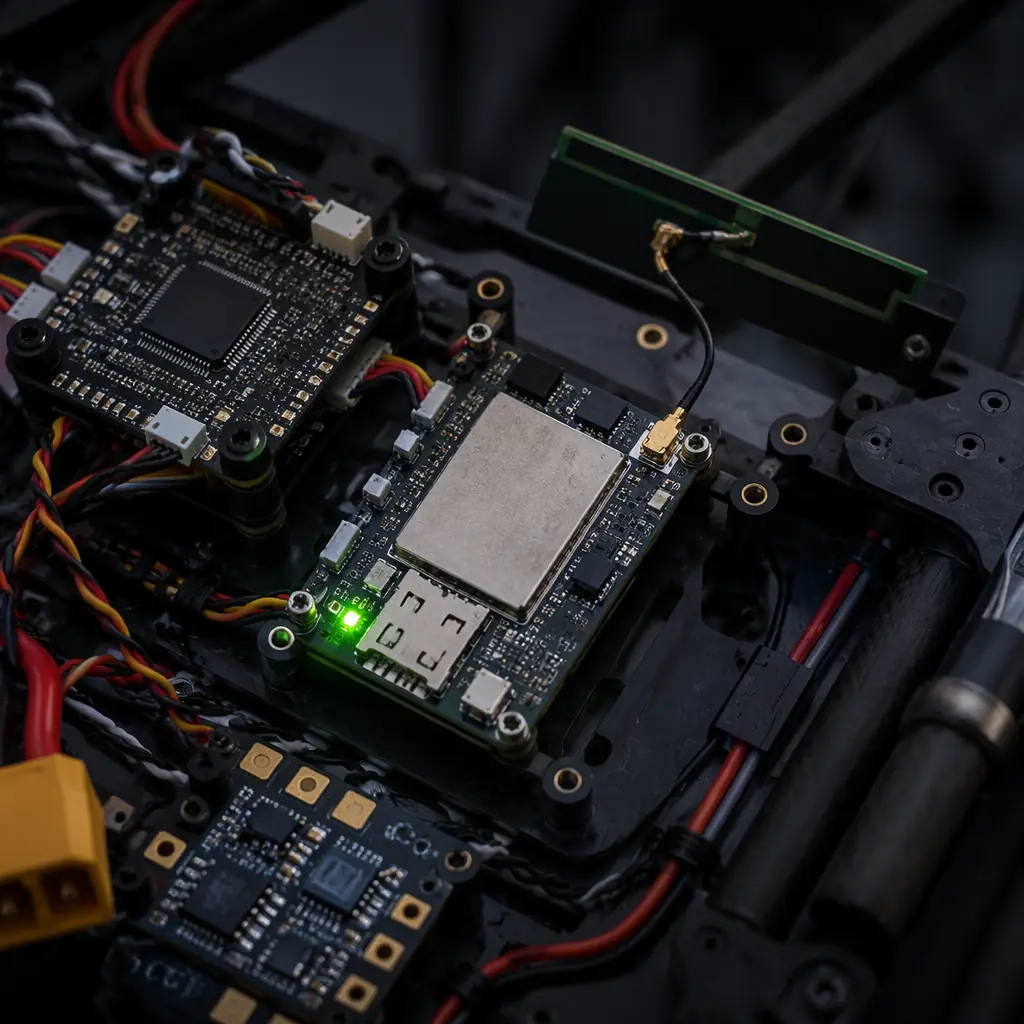
The Network Remote ID hardware stack is essentially a 4G/LTE modem with an integrated GPS receiver. The most common implementation uses a Quectel EC25 or EG25-G modem (LTE Cat 4, 150 Mbps downlink, 50 Mbps uplink, with integrated GNSS supporting GPS, GLONASS, BeiDou and Galileo) or a u-blox LARA-R6 series modem (LTE Cat 1, 10 Mbps downlink, 5 Mbps uplink, lower power consumption at 300–500 mW vs 1–2 W for Cat 4). The modem connects to the flight controller via UART — the flight controller sends the Remote ID message payload (or the raw GPS and altitude data) to the modem, and the modem encapsulates it in a HTTPS POST to the USS API endpoint. The modem also provides a secondary telemetry link — the same cellular connection that carries the Remote ID data can also carry command-and-control (C2) data for BVLOS operations, effectively combining Remote ID compliance and BVLOS communication into a single hardware component. The antenna configuration for Network Remote ID is more demanding than for Standard Remote ID broadcast: a cellular antenna must cover multiple bands (typically 700–2600 MHz for LTE Cat 4) and must be mounted with a ground plane of at least 100 mm × 50 mm to achieve adequate gain at the lower LTE bands (700–900 MHz). A 4G/LTE blade antenna or a PCB-embedded FPC antenna with a U.FL connector is the standard form factor for UAV installations, weighing 5–15 grams.
The procurement consideration for Network Remote ID is primarily about the USS integration, not the hardware module itself. The FAA maintains a list of approved USS providers — currently approximately 12 organizations including commercial drone fleet management platforms — and the Network Remote ID module must be compatible with at least one of these USS APIs. The module manufacturer typically provides a firmware image that includes the API integration for one or more USS providers; the procurement team must verify that the supported USS list includes a provider that serves the UAV's intended operational geography and that the USS subscription terms (some USS providers charge per-aircraft-per-month fees, others charge per-flight-hour) are compatible with the UAV operator's business model. The module's modem must also be certified for the cellular bands used in the UAV's operational region — a Quectel EC25-E (European bands) will not operate on U.S. LTE bands (Bands 2, 4, 5, 12, 13, 17, 66), and vice versa. The procurement specification must therefore include the target operational region and the required LTE band support, not just "4G/LTE modem."
 Concept illustration
EASA Direct Remote Identification: the European compliance hardware landscape
The European Union's DRI requirement — defined in Delegated Regulation (EU) 2019/945 Part 6 for the C1, C2 and C3 aircraft classes — is technically similar to the FAA's Standard Remote ID but differs in three hardware-relevant details that affect component selection for UAVs sold into the European market. First, EASA DRI requires that the Remote ID message include the UAV's unique registration number (the "operator registration number" issued by the national aviation authority of the operator's member state) rather than a manufacturer-assigned serial number. This means the Remote ID module must support field-programmable identification — the operator must be able to enter their registration number into the module, either through a USB connection to a configuration tool, through the flight controller's ground control station software, or through a mobile app that connects to the module via BLE. A module whose serial number is burned into firmware at the factory cannot comply with the EASA requirement without a firmware modification. Second, EASA DRI requires Wi-Fi Beacon transmission at 2.4 GHz (802.11 beacon frame format) or Wi-Fi NAN for the C1, C2 and C3 classes — BLE-only modules that comply with the FAA Standard Remote ID will not comply with EASA DRI unless they also include a Wi-Fi radio. Third, EASA DRI requires that the Remote ID function be "tamper-resistant and cannot be deactivated by the remote pilot during flight" — this is interpreted as a hardware-level requirement that the Remote ID module's power supply be independent of the flight controller's power management, such that turning off the flight controller (or resetting it in flight) does not remove power from the Remote ID module. This requirement aligns with the brownout-protection recommendation for Standard Remote ID modules but makes it a mandatory design constraint rather than a best practice.
The practical implication for procurement is that a single Remote ID module cannot serve both the U.S. and EU markets without dual-radio hardware and field-programmable identification. Modules that claim "global compliance" typically include a dual-mode BLE + Wi-Fi SoC (such as the ESP32-C3, which supports BLE 5.0 and Wi-Fi 4 at 2.4 GHz) and a USB or BLE configuration interface for the operator registration number. The procurement team should request the manufacturer's EASA DRI conformity assessment documentation — a Declaration of Conformity to Delegated Regulation (EU) 2019/945 Part 6, issued by an EASA-recognized notified body — and verify that the module's firmware version matches the version cited in the conformity assessment. For UAVs that will be certified under the EASA Specific category (the operational authorization pathway for BVLOS and other higher-risk operations, defined in Commission Implementing Regulation (EU) 2019/947), the UAV certification and compliance guide covers the broader certification requirements beyond the Remote ID component.
Detect-and-avoid sensors: the BVLOS hardware layer beyond Remote ID
Remote ID tells the airspace management system where the UAV is. Detect-and-avoid (DAA) tells the UAV where everything else is — and for BVLOS operations, DAA is the fundamental safety case requirement that enables the operation to be approved. The FAA's BVLOS ARC (Aviation Rulemaking Committee) final report and the EASA's Specific Operations Risk Assessment (SORA) methodology both require that the UAV demonstrate an "equivalent level of safety" to see-and-avoid for manned aircraft, which translates into a DAA system with defined detection range, probability of detection, and false alarm rate. The hardware components that implement DAA are diverse and procurement-intensive — a full DAA stack can add USD 5,000–50,000 to a UAV's BOM cost depending on the required detection range and the operational airspace class — but for the industrial UAV procurement team, understanding the component categories and their integration requirements is the prerequisite to writing a coherent procurement specification.
Acoustic detect-and-avoid. The simplest and lowest-cost DAA sensor, used primarily for detecting manned aircraft within approximately 1–3 km. An array of 4–8 MEMS microphones mounted on the UAV airframe detects the acoustic signature of approaching aircraft engines — a Cessna 172 produces a sound pressure level of approximately 70–80 dBA at 1 km, which is well above the background noise level of a UAV in forward flight (typically 55–65 dBA at the airframe surface). The acoustic DAA system uses beamforming algorithms to estimate the bearing of the sound source and cross-correlation between microphone pairs to estimate range, with an angular resolution of approximately 5–10 degrees and a detection range uncertainty of ±20–30% at 1 km. Acoustic DAA modules such as the Sagetech Avionics ACAS X or the Iris Automation Casia G are self-contained units weighing 200–500 grams, consuming 5–15 watts, and communicating with the flight controller via UART or CAN bus using a standardized DAA message protocol. The procurement consideration is the module's certification status — the FAA has not yet published an MoC for acoustic DAA, and the EASA SORA process requires a specific assurance and integrity level (SAIL) assessment for the DAA system as part of the operational authorization, which the module manufacturer should support with a compliance matrix document.
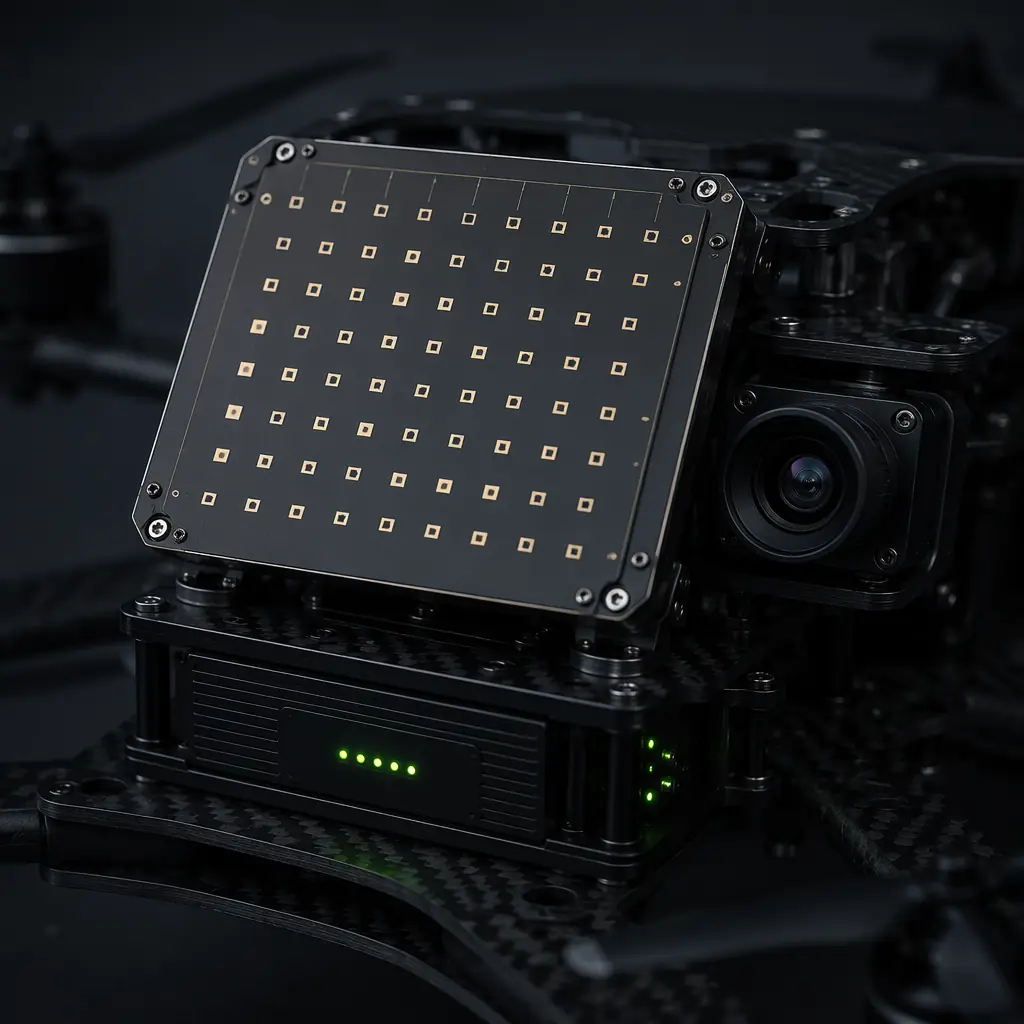
Radar-based detect-and-avoid. For detection ranges beyond 3 km and for operations in all weather conditions (acoustic DAA degrades in rain and wind), radar is the primary DAA sensor. A compact phased-array radar module operating in the 24 GHz ISM band or the 76–77 GHz automotive radar band — such as the Echodyne EchoFlight or the Fortem SkyDome — provides 3D tracking of cooperative and non-cooperative aircraft at ranges of 3–8 km, with a detection probability above 99% for aircraft with a radar cross-section of 1 m² or larger at 5 km. The radar module weighs 500–1,500 grams, consumes 15–50 watts, and communicates with the DAA processor (typically a separate single-board computer running the DAA fusion and avoidance logic) via Ethernet at 100 Mbps. The radar antenna must be mounted on the UAV with an unobstructed 360-degree field of view in the horizontal plane — on a multirotor, this typically means mounting the radar on the top of the airframe above the propellers; on a fixed-wing UAV, the radar is typically mounted in the nose or in a belly pod. The procurement specification for a radar DAA module must include the minimum detection range for a 1 m² target, the minimum detectable velocity (a hovering helicopter at near-zero relative velocity must be detectable), the update rate (at least 4 Hz for a closing target at 100 m/s, which gives approximately 12–15 detection updates before the closest point of approach at a 3 km initial detection range), and the false track rate (fewer than 0.1 false tracks per flight hour, to avoid unnecessary avoidance maneuvers).
 Concept illustration
Optical detect-and-avoid. For terminal-area operations — the last 500 meters of a delivery UAV's approach or the low-altitude inspection of a structure where other aircraft may be operating at the same altitude — optical DAA provides the highest angular resolution and the best ability to classify the detected object (aircraft vs bird vs balloon vs tower). A machine vision camera system with a global-shutter sensor (to eliminate rolling-shutter distortion during UAV motion), a telephoto lens with a 20–40 degree horizontal field of view, and a dedicated image processing unit running a convolutional neural network trained on a dataset of aircraft images achieves detection ranges of 500–2,000 meters for general aviation aircraft, depending on the camera resolution (a 5-megapixel sensor with a 40-degree horizontal FOV provides approximately 0.008 degrees per pixel, which resolves a Cessna 172 — wingspan approximately 11 meters — at 1.5 km as approximately 15 pixels). The optical DAA module communicates with the flight controller via UART (MAVLink OBSTACLE_DISTANCE message) or Ethernet, and the detection algorithm must run at a frame rate of at least 15 Hz to provide adequate warning time for a closing target at 50 m/s (approximately 180 km/h, representative of a light aircraft). The procurement specification for optical DAA must include the minimum detection range in the mission's expected visibility conditions (specify the meteorological visibility in km or the atmospheric extinction coefficient), the detection probability for a 1 m² target at the specified range, and the false positive rate per flight hour (a false positive triggers an unnecessary avoidance maneuver, which wastes battery capacity and may violate the UAV's operational airspace bounds).
For UAVs operating in defense or public safety applications where the DAA requirement includes non-cooperative and potentially hostile aircraft, the defense and security components guide covers the EW-hardened DAA sensors and the encrypted data links that connect them. For the communications infrastructure that carries the Remote ID and DAA data — especially the 4G/LTE and 868/915 MHz telemetry links that provide the command-and-control path for BVLOS operations — the UAV RF communication systems guide covers the frequency band selection, antenna design and link budget analysis for the complete communication stack.
Remote ID component procurement checklist
The following checklist is a procurement-ready summary of the verification items that must be confirmed for every Remote ID and DAA component before placing a purchase order. Each item includes the specific data point, the acceptable range or value, and the verification method.
Standard Remote ID broadcast module. Verify the FAA Declaration of Compliance — check the FAA's public DoC list for the module manufacturer and firmware version, and confirm that the DoC covers the module's transmission method (BLE or Wi-Fi NAN). Verify the GPS/GNSS receiver specifications: horizontal accuracy ≤3 meters CEP with SBAS, cold-start TTFF ≤30 seconds, update rate ≥1 Hz. Verify the broadcast message format compliance: ASTM F3411-22a message set, all required fields populated (serial number, latitude, longitude, barometric altitude, geometric altitude, velocity N/E/D, time mark, emergency status, control station location). Verify the integration interface: UART at ≥115,200 bps with MAVLink REMOTE_ID message (message ID #283) or CAN bus with DroneCAN uavcan.equipment.remote_id message. Verify the power characteristics: supply voltage range compatible with the UAV's avionics power bus (typically 3.3 V or 5 V), maximum current draw at the specified voltage, brownout ride-through capability (≥200 ms at minimum input voltage).
Network Remote ID endpoint. Verify the USS provider compatibility: list of supported USS providers, API version, and any per-aircraft or per-flight-hour subscription fees. Verify the cellular band support for the target operational region: North America (LTE Bands 2, 4, 5, 12, 13, 17, 66), Europe (Bands 1, 3, 7, 8, 20, 28), or multi-region (global LTE Cat 4 or Cat 1 module with region-specific firmware). Verify the modem certification: FCC ID for U.S. operations, CE marking for EU operations, PTCRB or GCF certification for network operator acceptance. Verify the GPS/GNSS receiver performance: same as Standard Remote ID module, with the additional requirement that the GNSS fix must be maintained during cellular transmission (some GNSS receivers experience sensitivity degradation — "desense" — when a nearby cellular transmitter is active, requiring a GNSS antenna with ≥15 dB of out-of-band rejection at the cellular transmit frequencies).
EASA DRI module (dual-market UAVs). All Standard Remote ID verification items, plus: verify the Wi-Fi Beacon or Wi-Fi NAN transmission capability (BLE-only modules are non-compliant with EASA DRI), verify the field-programmable operator registration number (through USB, BLE GATT service, or ground control station configuration), verify the independent power supply (Remote ID module power not interruptible by flight controller reset), verify the EASA Declaration of Conformity to Delegated Regulation (EU) 2019/945 Part 6 and the notified body that issued it.
Detect-and-avoid sensor. Verify the detection range for the target aircraft class (specify the target's radar cross-section or visual cross-section). Verify the detection probability at the specified range (≥95% for cooperative DAA, ≥99% for non-cooperative DAA). Verify the false track or false positive rate (≤0.1 per flight hour). Verify the DAA processor compatibility with the flight controller (MAVLink OBSTACLE_DISTANCE or TRAFFIC_REPORT message support). Verify the DAA system's SAIL assessment for the intended operational authorization category under EASA SORA. For radar DAA: verify the transmit frequency band is authorized for operation in the UAV's airspace jurisdiction (24 GHz ISM is unlicensed in most jurisdictions; 76–77 GHz is automotive radar band and may require specific authorization for airborne use).
Integration architecture: connecting Remote ID to the avionics stack
The Remote ID module is not a standalone device — it is a node in the avionics data network that consumes GPS, barometric altitude and emergency status data from the flight controller and transmits the assembled Remote ID message through its BLE/Wi-Fi radio or cellular modem. The integration architecture determines the data flow, the failure modes and the redundancy strategy, and it must be specified before the Remote ID module is selected — because a module that communicates via MAVLink UART cannot integrate with a flight controller that only supports DroneCAN, and vice versa.
The most common integration architecture for industrial UAVs uses the flight controller's serial port (TELEM2 or SERIAL4 on Pixhawk-family flight controllers, configured as MAVLink 2 at 115,200 bps) to connect to the Remote ID module's UART. The flight controller firmware — ArduPilot 4.1 or later, PX4 1.13 or later — includes a Remote ID driver that reads the UAV's dynamic state from the EKF (Extended Kalman Filter) output and formats it into the MAVLink REMOTE_ID message at 1 Hz. The Remote ID module receives the REMOTE_ID message, appends its own static data (serial number, module firmware version, self-test status), formats the complete message according to the ASTM F3411 message set, and broadcasts it via BLE. This architecture is simple, well-documented and supported by the major open-source flight controller platforms, but it has a single point of failure: if the flight controller's serial port fails or the MAVLink stream is interrupted, the Remote ID module stops receiving dynamic data — and although the module continues to broadcast the last received position, the time mark field in the message will indicate that the position data is stale, which is a compliance violation under both FAA and EASA regulations. The mitigation is to implement a watchdog in the Remote ID module's firmware that triggers a compliance alert (a dedicated status LED pattern or a MAVLink STATUSTEXT message back to the ground control station) if the dynamic data stream has been interrupted for more than 5 seconds.
An alternative architecture that provides higher reliability — and is becoming the preferred approach for BVLOS UAVs — uses a dedicated GPS/GNSS receiver and barometer on the Remote ID module itself, independent of the flight controller. In this architecture, the Remote ID module receives the GPS and barometer data directly from its own sensors, and the flight controller connection is reduced to monitoring only (the flight controller reads the Remote ID module's self-test status and alerts the operator if the module is not broadcasting). This architecture eliminates the flight controller as a single point of failure for Remote ID compliance and is the recommended approach for UAVs that will operate under BVLOS waivers or EASA Specific category authorizations, where the operational authorization is conditional on Remote ID availability throughout the flight. The hardware cost increment is approximately USD 15–25 for the dedicated GPS receiver and barometer — a negligible addition to a BVLOS UAV's BOM cost of USD 5,000–50,000. The procurement specification for a Remote ID module in this architecture must include the dedicated sensor specifications and must verify that the module's firmware supports fully autonomous operation (broadcasting Remote ID messages without receiving data from the flight controller) and that the module's self-test status is readable by the flight controller via MAVLink or CAN.
For the broader avionics integration considerations — including the serial port allocation, the CAN bus termination and the power distribution architecture that supplies the Remote ID module — the flight controller and ESC matching guide covers the avionics bus architecture and the serial port mapping strategy for multi-peripheral UAV configurations. The UAV payload integration guide addresses the payload interface that may share the serial bus or the CAN bus with the Remote ID module, and the bus bandwidth allocation considerations when multiple peripherals compete for the same communication channel.
Procurement timeline and supply chain readiness
The Remote ID component supply chain is maturing rapidly but still exhibits lead-time variability that catches procurement teams off guard. As of mid-2026, the typical lead time for a FAA DoC-listed Standard Remote ID broadcast module is 4–8 weeks for volumes of 100–1,000 units — but this extends to 12–16 weeks if the module uses a Nordic nRF52 BLE SoC, which has been subject to allocation constraints since the 2024–2025 semiconductor shortage. Modules based on the Espressif ESP32-C3 (which is fabricated at TSMC's 40 nm node and has not been subject to allocation) typically ship in 4–6 weeks. The procurement team should maintain a 12-week buffer stock of Remote ID modules — the cost of carrying USD 50–150 per module in inventory for 3 months (approximately USD 1.25–3.75 per module at a 10% annual carrying cost) is vastly lower than the cost of grounding a UAV fleet because Remote ID modules are on backorder and the UAV cannot legally operate. For UAVs that will be sold into both U.S. and EU markets, the dual-band BLE + Wi-Fi module stock should be proportionally larger, because the same module serves both markets and supply disruptions affect both revenue streams simultaneously.
The DAA sensor supply chain is a different category entirely. Acoustic DAA modules are produced in relatively low volumes — the total market for UAV DAA sensors is approximately 10,000–15,000 units per year across all manufacturers — and lead times can extend to 16–24 weeks for orders above 50 units. Radar DAA modules are even more constrained, with a small number of suppliers (Echodyne, Fortem, Robin Radar) serving a market that is growing at 40–60% per year but from a base of only 2,000–3,000 units annually. The procurement strategy for DAA sensors should therefore include a 6-month lead-time buffer and a dual-source qualification program — qualify at least two DAA sensor suppliers for each sensor type (acoustic, radar, optical) and maintain qualification test reports for both, so that a supply disruption at one supplier can be absorbed by shifting volume to the other without a requalification delay. The UAV supplier evaluation checklist provides a framework for qualifying Remote ID and DAA component suppliers against the same criteria used for flight controllers, ESCs and propulsion components — including supply chain traceability, certification documentation maturity and production capacity verification.
Explore custom engineering Back to Blog
Continue Reading
Certification & Compliance Guide
CE, FCC, NDAA and ISO 9001 certification requirements for UAV components — the broader compliance framework that includes Remote ID.
UAV RF Communication Systems
Frequency band selection, antenna design and link budget analysis for the 4G/LTE and ISM-band links that carry Remote ID and C2 data.
Defense & Security Components
EW-hardened DAA sensors and encrypted data links for defense UAVs — where Remote ID data must be protected from interception.
FC & ESC Matching
Avionics bus architecture and serial port mapping strategy — the integration baseline for adding a Remote ID module to the UAV stack.
Payload Integration Guide
Payload interfaces that share the serial or CAN bus with Remote ID — bandwidth allocation when multiple peripherals share one channel.