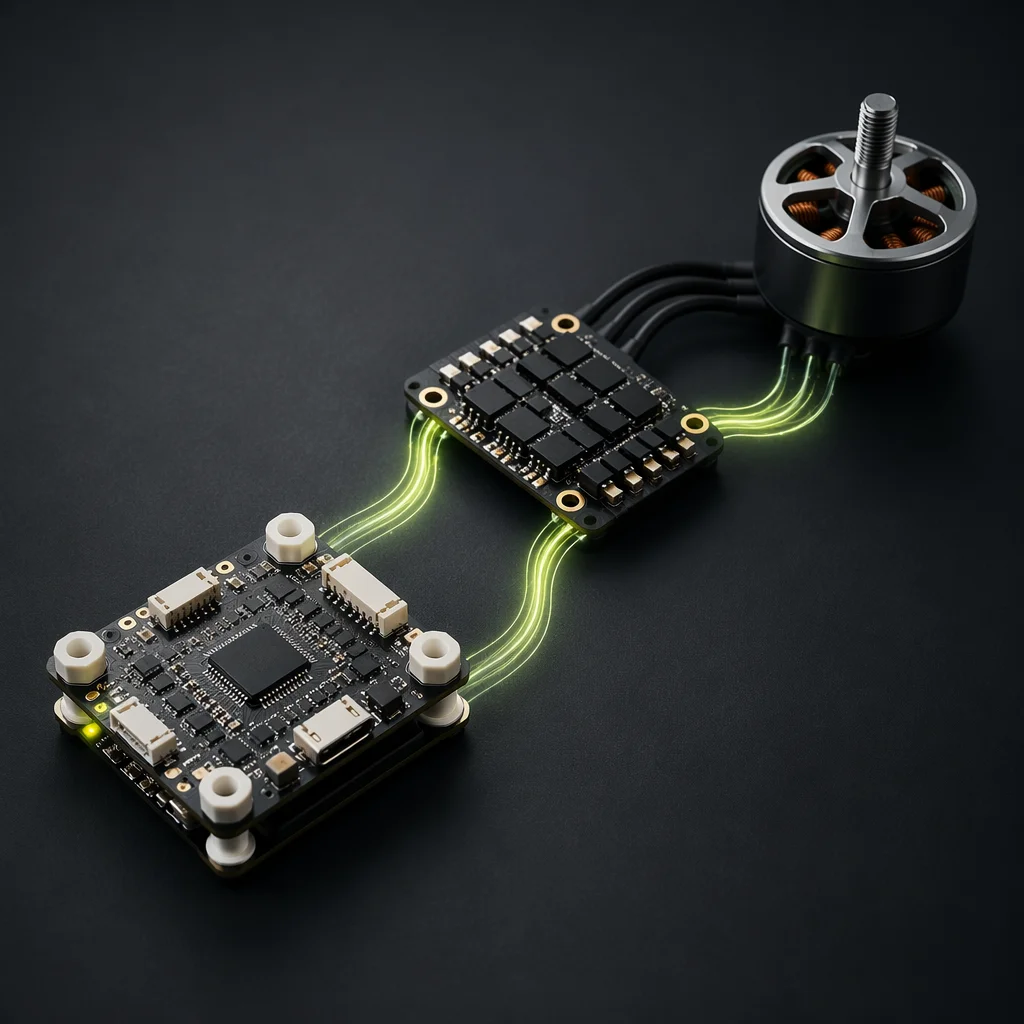
Flight controllers and electronic speed controllers sit at the center of how a UAV senses, decides and converts commands into thrust. Selecting them independently is a common source of late-stage rework: wiring changes, firmware limits, unexpected heat or motor behavior that does not match the airframe.
Start with the shared interfaces
Before comparing feature lists, document the interfaces that bind the control and power layers:
- Communication protocol — how the controller issues motor commands and receives feedback
- Voltage architecture — pack voltage, distribution and what the ESC and peripherals expect
- Current and thermal context — continuous and peak demand relative to mounting and airflow
- Firmware and configuration path — parameters, calibration steps and bench-check expectations
These are system questions. Answering them early reduces the chance that a “good” board or ESC becomes the wrong fit for the rest of the stack.
Coordinate motors and mechanical fit early
ESC selection is incomplete without motor and propeller context. Kv, prop load, mounting geometry and wire routing all influence whether the electrical path stays within a workable envelope. Likewise, controller placement affects sensor noise, cable length and access for service.
Treat the propulsion decision as a chain: controller ↔ ESC ↔ motor ↔ prop ↔ structure. Changing any link should reopen the compatibility review for the adjacent links.
A practical matching sequence
- Capture mission priorities that drive thrust and endurance assumptions
- Lock or shortlist the voltage and protocol constraints
- Review ESC topology and motor options against those constraints
- Confirm controller I/O, telemetry and firmware alignment
- Plan bench checks for direction, power path and parameter sanity before flight
Exact product options and ranges should be reviewed against your technical brief. Published catalogs alone rarely capture harness, thermal or firmware edge cases.
Education, not a deployment story
This note is industry education for teams building or sourcing UAV stacks. It does not claim a specific customer outcome, certified configuration or production capacity. Use it to structure the conversation—then validate with your mission and interface data.