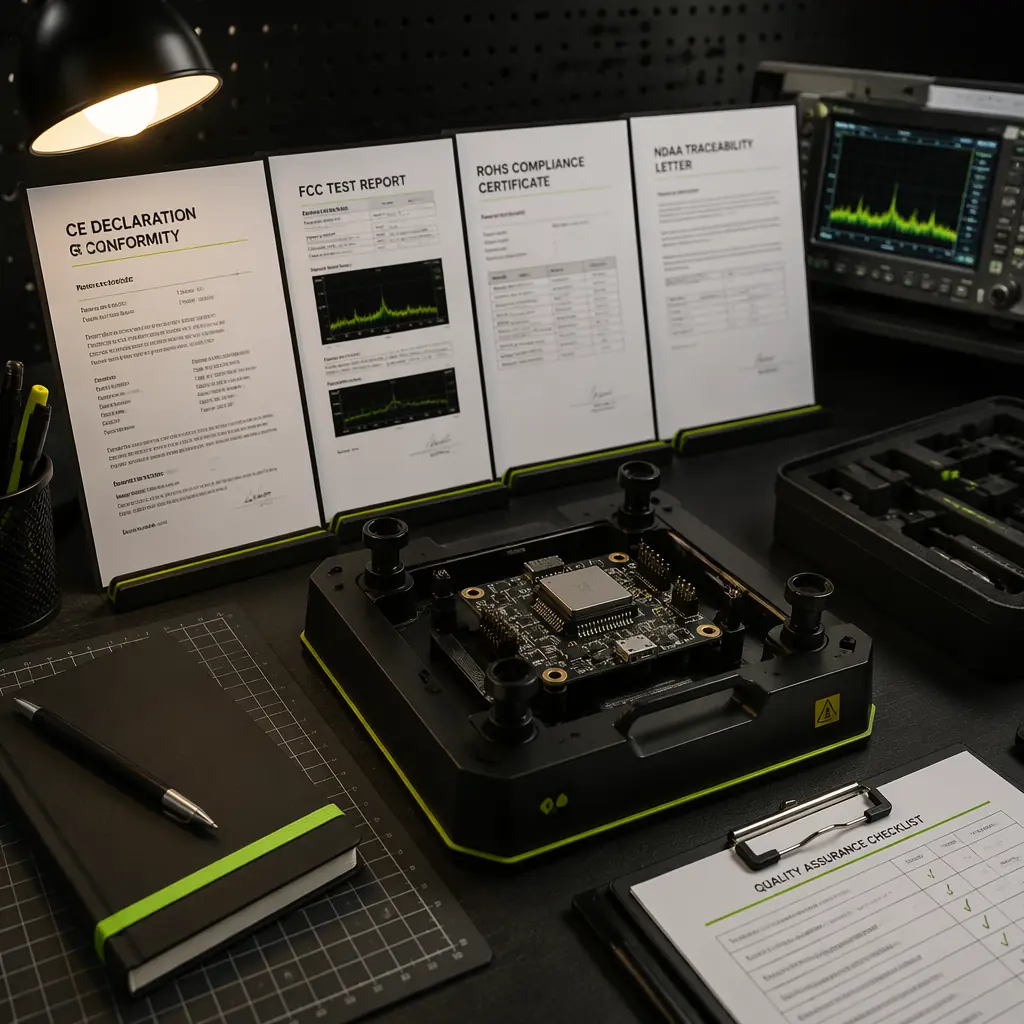
When a UAV component shipment is detained at the port of Rotterdam because the CE marking documentation is incomplete, or when a U.S. defense prime rejects a flight controller because the IMU's semiconductor foundry cannot be verified as non-PRC under NDAA Section 848, or when a European drone manufacturer's ISO 9001 surveillance audit flags a component supplier whose RoHS compliance certificate expired six months ago — none of these scenarios are hypothetical. They are the routine operational reality of the UAV component supply chain as it scales from thousands of units per year (the hobby and prosumer market) to tens of thousands (the enterprise market) to hundreds of thousands (the defense and government market). At each volume threshold, the certification burden increases discontinuously: a component that sells 500 units per year into the hobby market with no certifications beyond a CE self-declaration will be rejected at 5,000 units per year by an enterprise customer whose own ISO 9001 quality management system requires documented supplier qualification, and will be rejected at 50,000 units per year by a defense prime whose contract requires NDAA compliance verification for every semiconductor on the bill of materials.
The certification landscape for UAV components is not static — three regulatory changes in 2024–2026 have significantly expanded the compliance surface. First, the EU's Cyber Resilience Act (CRA), adopted in October 2024 and entering phased enforcement from late 2026, will require UAV components with digital elements — flight controllers with firmware update capability, communications modules with configurable RF parameters, ground control station software — to carry CE marking under the CRA in addition to the existing CE marking under the Radio Equipment Directive and EMC Directive, adding a cybersecurity assessment to the conformity procedure for the first time. Second, the U.S. Department of Commerce's Bureau of Industry and Security (BIS) published an advanced notice of proposed rulemaking in March 2025 on expanding the export controls on UAV-related technologies — specifically flight controller firmware with autonomous navigation capability, swarming algorithms and AI-based target recognition — which would move these items from EAR99 (no license required) to a CCL classification requiring an export license. Third, the NDAA for Fiscal Year 2025 expanded Section 848's covered foreign country definition to potentially include additional countries beyond the PRC, and introduced a requirement for the Secretary of Defense to maintain a publicly accessible list of NDAA-compliant UAV components — the Blue UAS Framework 2.0 — that will become the de facto procurement standard for allied defense ministries. Every one of these regulatory changes affects the component selection decision for a UAV integrator planning a product with a 3–5 year production lifecycle.
CE marking: the European Economic Area gateway
CE marking is not a quality certification — it is a regulatory conformity mark that declares the product complies with all applicable EU harmonization legislation and is therefore eligible for free movement within the European Economic Area (EU member states plus Iceland, Liechtenstein and Norway). For a UAV component, the CE marking surface typically covers three directives: the Electromagnetic Compatibility (EMC) Directive 2014/30/EU, the Radio Equipment Directive (RED) 2014/53/EU, and the Restriction of Hazardous Substances (RoHS) Directive 2011/65/EU as amended by Directive 2015/863 (RoHS 3). A component that complies with EMC and RED but not RoHS cannot legally carry the CE mark — full compliance with all applicable directives is required before the mark can be affixed.
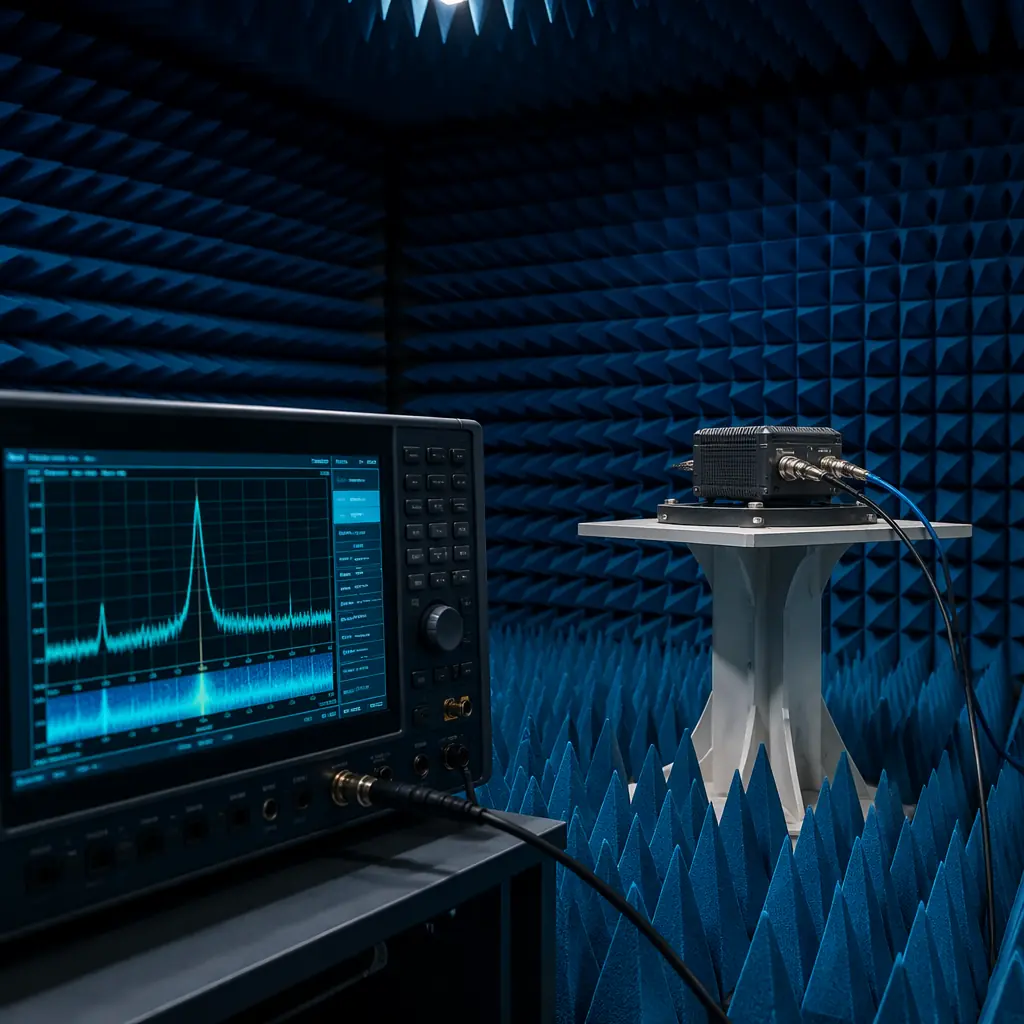
EMC Directive 2014/30/EU: applicable standards for UAV components. The EMC Directive requires that equipment neither generates electromagnetic disturbance exceeding a level that prevents other equipment from operating as intended (emissions), nor has an inadequate level of immunity to electromagnetic disturbance that prevents it from operating as intended (immunity). For UAV components, the applicable harmonized standards are EN 55032:2015 (electromagnetic emissions from multimedia equipment, Class A for industrial environments or Class B for residential — a UAV flight controller operating in an industrial UAV is Class A, but a communications module that may be used in a consumer-accessible UAV is Class B) and EN 55035:2017 (electromagnetic immunity for multimedia equipment, covering electrostatic discharge per EN 61000-4-2 at ±8 kV contact / ±15 kV air discharge, radiated RF immunity per EN 61000-4-3 at 3 V/m from 80 MHz to 6 GHz, and electrical fast transients per EN 61000-4-4 at ±1 kV on signal and control ports). The EMC conformity assessment for a UAV component typically follows Module A (internal production control) — the manufacturer performs the testing, compiles the technical documentation including the test report, and issues the EU Declaration of Conformity. No notified body involvement is required for EMC compliance unless the manufacturer chooses to use a notified body for testing — which is recommended for components integrating multiple RF transmitters where the co-location emissions profile is complex.
Radio Equipment Directive 2014/53/EU: intentional radiators. Any UAV component that intentionally emits radio waves — flight controller with integrated telemetry radio, dedicated communications module, GNSS receiver with active antenna (which emits a local oscillator signal), video transmitter — falls under the RED. The RED requires conformity with Article 3.1(a) (health and safety, referencing EN 62368-1 for audio/video and IT equipment safety), Article 3.1(b) (electromagnetic compatibility, referencing the same EMC standards as the EMC Directive), and Article 3.2 (effective and efficient use of the radio spectrum). The spectrum efficiency requirement — Article 3.2 — is the RED-specific addition that requires testing to harmonized standards for the specific frequency band: EN 300 328 for 2.4 GHz wideband data transmission systems (Wi-Fi, Bluetooth, proprietary 2.4 GHz telemetry), EN 300 220 for short-range devices in the 25–1,000 MHz range (868 MHz and 915 MHz telemetry radios), and EN 303 413 for GNSS receivers. For a UAV communications module operating at 2.4 GHz and 868 MHz simultaneously, both EN 300 328 and EN 300 220 testing must be completed and included in the technical file. The RED conformity assessment for a UAV component is almost always Module A (internal production control) — but if the component uses a radio technology not covered by a harmonized standard (such as a proprietary FHSS waveform not aligned with EN 300 328), the conformity assessment must involve a notified body (Module B + C or Module H), which adds 6–12 weeks and EUR 8,000–20,000 to the certification timeline and budget.
 Concept illustration
RoHS 3 (Directive 2015/863) and REACH. RoHS restricts ten substances in electrical and electronic equipment: lead (0.1% by weight), mercury (0.1%), cadmium (0.01%), hexavalent chromium (0.1%), polybrominated biphenyls / PBB (0.1%), polybrominated diphenyl ethers / PBDE (0.1%), bis(2-ethylhexyl) phthalate / DEHP (0.1%), butyl benzyl phthalate / BBP (0.1%), dibutyl phthalate / DBP (0.1%) and diisobutyl phthalate / DIBP (0.1%). For a UAV component — a flight controller PCB with lead-free HASL or ENIG surface finish, assembled with RoHS-compliant solder (SAC305 or similar tin-silver-copper alloy) — the primary RoHS non-compliance risk is not the PCB assembly itself (which is routinely manufactured to RoHS standards) but the connectors, cables and ancillary components: PVC-insulated wiring with DEHP plasticizer, brass connectors with lead content above 0.1% at the bulk material level (not just the surface plating), and conformal coating materials containing restricted phthalates. The RoHS compliance documentation for a UAV component must include a bill of materials with every homogeneous material (not just every component) assessed for the ten restricted substances, supplier declarations for all bought-in parts, and a test report from an ISO/IEC 17025 accredited laboratory for any material where the supplier declaration is unavailable or unreliable. REACH (Regulation EC 1907/2006) adds an additional requirement: if the component contains any substance on the Candidate List of Substances of Very High Concern (SVHC) at a concentration above 0.1% by weight, the supplier must provide a REACH Article 33 communication to the downstream user identifying the SVHC and providing safe-use information. As of mid-2026, the SVHC Candidate List contains 240 substances — approximately 20 of which are relevant to electronics manufacturing, including certain phthalates, flame retardants and solder flux residues.
FCC certification: intentional radiators for the U.S. market
Any UAV component that intentionally emits radio frequency energy and is marketed or operated in the United States must be certified under FCC Part 15 — specifically, Subpart C for intentional radiators — before it can be legally sold, imported or operated. Unlike the CE marking system where the manufacturer self-declares conformity for most product categories, the FCC certification process for intentional radiators requires testing by an FCC-recognized accredited testing laboratory and filing of the test report with an FCC-recognized Telecommunications Certification Body (TCB) that issues the FCC Grant of Equipment Authorization. The distinction matters for UAV component procurement: a supplier that says "this module is FCC compliant" but cannot produce an FCC ID — a unique identifier issued by the TCB and visible in the FCC's Equipment Authorization Search database — has not completed FCC certification. The module may be functionally identical to a certified version, but without the FCC ID and the underlying test report, it cannot be legally used in a UAV sold into the U.S. market.
FCC Part 15C: applicable rule parts for UAV components. The FCC rule parts that apply to UAV components depend on the frequency band and modulation: 15.247 for frequency-hopping and digitally modulated intentional radiators in the 902–928 MHz, 2400–2483.5 MHz and 5725–5850 MHz bands (this covers most 900 MHz telemetry radios, 2.4 GHz Wi-Fi and proprietary data links, and 5.8 GHz video transmitters); 15.249 for low-power devices operating in the 902–928 MHz, 2400–2483.5 MHz, 5725–5875 MHz and 24.0–24.25 GHz bands with field strength limits rather than conducted power limits (this covers low-power telemetry radios with output power below 1 mW and duty-cycle-limited sensors); and 15.407 for Unlicensed National Information Infrastructure (U-NII) devices in the 5.15–5.25 GHz, 5.25–5.35 GHz, 5.47–5.725 GHz and 5.725–5.85 GHz bands. A UAV communications module operating at 2.4 GHz with a 20 dBm conducted output power and a 20 MHz bandwidth must be certified under 15.247 with testing for maximum peak conducted output power (not to exceed 1 watt / 30 dBm for systems using digital modulation with at least 15 dB of antenna gain plus minimum directional gain), power spectral density (not to exceed 8 dBm in any 3 kHz band), and occupied bandwidth (at least 500 kHz for DTS systems). The FCC test report must be filed by a TCB and the FCC ID issued before the module can be shipped to a U.S. customer. The certification process typically takes 4–8 weeks and costs USD 8,000–18,000 per module variant, depending on the number of frequency bands and the complexity of the co-location testing if the module integrates multiple radios. For a procurement team evaluating a UAV communications module, the UAV RF communication systems guide covers the link budget and antenna gain calculations that are inputs to the FCC conducted power compliance assessment.
FCC modular approval vs. limited single-modular approval. A UAV component supplier can pursue FCC certification under two paths: full modular approval (the transmitter is tested as a stand-alone module with a specified antenna type and gain, and any host device that integrates the module inherits the module's FCC certification without additional transmitter testing, provided the integration follows the module's integration guide) or limited single-modular approval (LMA, where the transmitter is tested in a specific host configuration — such as a specific UAV airframe — and the certification is valid only for that host). Full modular approval is the procurement team's preference because it eliminates the need for additional FCC testing when the module is integrated into the UAV — the module's FCC ID can be referenced in the UAV's FCC Supplier's Declaration of Conformity (SDoC) for the unintentional radiator portion of the UAV (the digital circuitry that is not an intentional radiator, assessed under FCC Part 15B). An LMA, by contrast, requires the UAV integrator to either re-file the module for modular approval (which means repeating the transmitter testing at the integrator's expense) or file the UAV as a composite system with the module integrated, which adds 4–8 weeks and USD 5,000–12,000 to the UAV's certification timeline and budget.
NDAA Section 848: the U.S. defense procurement gate
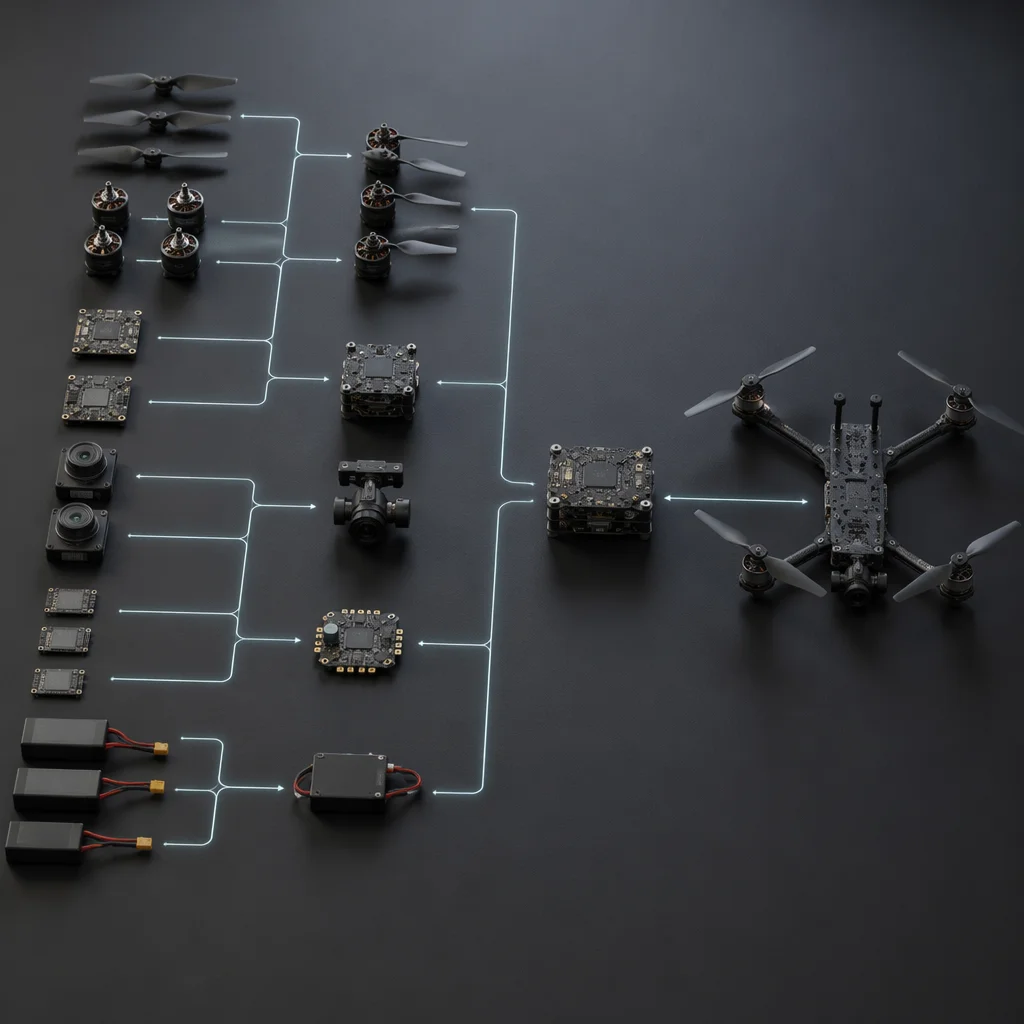
Section 848 of the National Defense Authorization Act for Fiscal Year 2020 — codified at 10 U.S.C. § 487c and expanded by subsequent NDAA legislation through FY 2025 — prohibits the U.S. Department of Defense from procuring or operating unmanned aircraft systems manufactured by entities from covered foreign countries, and from procuring UAS components — flight controllers, ESCs, motors, cameras, communications equipment, navigation systems and ground control stations — manufactured by entities from covered countries. The current covered foreign country is the People's Republic of China, with the FY 2025 NDAA directing the Secretary of Defense to assess additional countries for inclusion. The practical scope of NDAA Section 848 extends beyond DoD procurement: the U.S. Department of the Interior (which operates approximately 900 UAVs for wildfire monitoring, wildlife survey and land management) issued an operational order in 2023 grounding all PRC-manufactured UAVs and components regardless of the funding source, and the U.S. General Services Administration has proposed adding NDAA compliance as a mandatory evaluation factor in all federal UAV procurement solicitations. Allied defense ministries — the UK Ministry of Defence, the Australian Department of Defence, the Canadian Department of National Defence, and the Japanese Ministry of Defense — have each published procurement guidance documents that reference NDAA Section 848 compliance as a condition for UAV component procurement, even when the procurement is funded entirely by the allied nation's own defense budget.
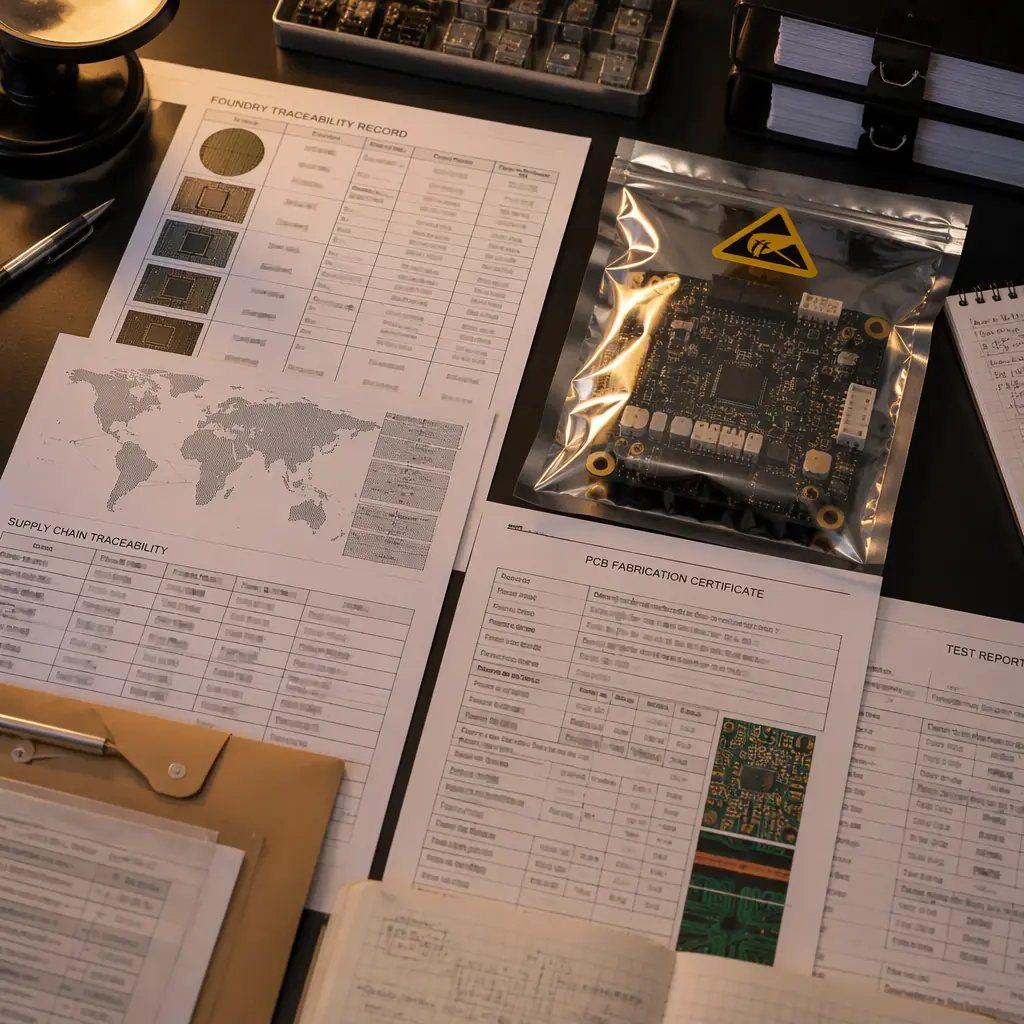
Component traceability: semiconductor foundry and PCB fabrication. The operational requirement of NDAA Section 848 is traceability of every semiconductor device on the component's bill of materials to the wafer fabrication facility — not just the semiconductor company that sells the part, but the physical foundry where the silicon wafer was processed. A flight controller that uses an STM32H743 microcontroller is NDAA-compliant because STMicroelectronics fabricates this device at its own fabs in Agrate Brianza and Catania, Italy, and in Crolles, France, as well as at its Singapore joint-venture fab — none of which are in the PRC. A flight controller that uses a GigaDevice GD32F407 — a pin-compatible STM32F407 clone — is not NDAA-compliant because GigaDevice is a PRC-headquartered semiconductor company and its fabrication is performed at SMIC (Semiconductor Manufacturing International Corporation) fabs in Shanghai and Beijing. The traceability requirement extends to the IMU (InvenSense/TDK = compliant, fabricated in Taiwan and Japan; Bosch Sensortec = compliant, fabricated in Germany), the barometric pressure sensor (Bosch BMP390 = compliant; Goertek SPL06 = not compliant, PRC-headquartered), the GNSS receiver (u-blox = compliant if the module is manufactured at u-blox's facilities in Switzerland or Thailand; Quectel = not compliant, PRC-headquartered) and the RF power amplifier (Skyworks, Qorvo, Analog Devices = compliant; Maxscend, Lansus = not compliant). The PCB fabrication facility is equally critical: a flight controller assembled on a 6-layer PCB fabricated by WUS Printed Circuit or Unimicron (Taiwan-headquartered, fabrication in Taiwan) is NDAA-compliant; the same flight controller assembled on a PCB fabricated by Shennan Circuits or Avary Holding (PRC-headquartered, fabrication in Shenzhen, PRC) is not NDAA-compliant, even if every semiconductor on the board is from a non-PRC foundry.
The Blue UAS Framework 2.0 and Cleared List. The U.S. Defense Innovation Unit (DIU) manages the Blue UAS program — a framework for validating NDAA-compliant UAV components and making them available to DoD, federal civilian agencies and allied defense ministries through a publicly accessible Cleared List. As of mid-2026, the Blue UAS Cleared List includes approximately 35 flight controllers, 20 ESCs, 15 communications modules, 10 ground control stations and 8 complete UAV platforms across Group 1 and Group 2 classifications. A component that is on the Cleared List has been validated by DIU for NDAA compliance, cybersecurity (per the DIU Cyber Safety Framework) and supply-chain security — meaning the procurement team can source the component with documented evidence that it meets all three requirements, rather than having to independently verify semiconductor provenance for every device on the BOM. However, the Cleared List is not exhaustive: a component that is not on the list may still be NDAA-compliant if the manufacturer provides a documented traceability package — semiconductor foundry names and locations, PCB fabrication facility name and location, firmware development entity location and ownership — that an independent third party can verify. For the procurement methodology that validates NDAA compliance for components not on the Cleared List, the UAV supplier evaluation checklist provides the 10-point audit framework that a procurement team can apply to any component supplier.
 Concept illustration
ITAR and EAR: the dual-use export control boundary
The export of UAV components from the United States is controlled by two regulatory regimes: the International Traffic in Arms Regulations (ITAR), administered by the U.S. Department of State's Directorate of Defense Trade Controls (DDTC), and the Export Administration Regulations (EAR), administered by the U.S. Department of Commerce's Bureau of Industry and Security (BIS). The boundary between ITAR and EAR for UAV components is defined by the U.S. Munitions List (USML) Category VIII — which controls military aircraft and related articles — and Category XII — which controls fire control, laser, imaging and guidance equipment. A UAV component that is not specifically designed, developed, configured, adapted or modified for a military application is generally subject to the EAR, not the ITAR — but the "specifically designed" determination is fact-specific and depends on the component's performance characteristics, not its marketing description.
ITAR-controlled UAV components: the USML Categories. USML Category VIII(h) controls UAVs and their components that are "specifically designed for military use" and have any of the following: a maximum endurance of 4 hours or more, an operating altitude of 15,000 feet or more, a payload capacity of 20 pounds or more, or the ability to carry a weapon or deliver a payload to a specific location with an accuracy of 10 meters CEP or less. The component-level control under Category VIII(h)(1) covers flight controllers, autopilots, navigation systems, communications systems, propulsion systems, airframes and payloads that are "specifically designed" for a UAV meeting one of these thresholds. USML Category XII(c) controls imaging systems with a frame rate greater than 9 Hz that are "specifically designed for military applications" — which captures thermal cameras on defense UAVs that operate at 30 Hz or 60 Hz for moving-target tracking. USML Category XII(d) controls laser systems designed for target designation or range-finding used with fire control systems — which captures laser designators on loitering munitions and laser range-finders integrated with a target geo-location function. A procurement team evaluating a UAV component for export must first determine whether the component is ITAR-controlled (in which case export requires a DSP-5 license from DDTC, with a processing time of 30–60 days for friendly foreign governments and 6–12 months for commercial export to non-government end-users in non-embargoed countries) or EAR-controlled (in which case export is governed by the Commerce Control List classification and may be eligible for a license exception such as Strategic Trade Authorization / STA for certain allied destinations).
EAR classification: ECCNs for common UAV components. Under the EAR, UAV components are classified under Export Control Classification Numbers (ECCNs) on the Commerce Control List (CCL). The common ECCNs for commercial UAV components are: 7A611 for "military electronics" not enumerated in USML Category VIII or XII — this captures flight controllers, autopilots and navigation systems that have military capability but do not meet the "specifically designed for military use" threshold of the ITAR (export controlled for anti-terrorism / AT reasons to all destinations except Canada); 7A994 for "marine, aerospace and propulsion equipment" — this captures UAV airframes, propulsion systems and electro-mechanical components not elsewhere specified (export controlled for AT reasons); 6A003 for "cameras, systems or equipment" — this captures thermal cameras with frame rates up to and including 9 Hz (export controlled for national security / NS and AT reasons, with license exception eligibility for certain destinations); and 5A001 for "telecommunications systems, equipment and components" — this captures encrypted communications modules with encryption exceeding 56 bits symmetric key length, which includes AES-256 UAV data links (export controlled for NS and AT reasons, with license exception ENC eligibility for most commercial and dual-use products). An EAR99 classification — meaning the component is subject to the EAR but not listed on the CCL — applies to basic structural components, non-encrypted commercial telemetry radios, standard brushless motors and propellers, and other UAV components that do not have a specific ECCN. EAR99 items can be exported to most destinations without a license (excluding embargoed countries: Cuba, Iran, North Korea, Syria, and the Crimea, Donetsk and Luhansk regions of Ukraine).
ISO 9001 and the quality management documentation chain
ISO 9001:2015 is not a UAV-specific certification — it is the international standard for quality management systems across all industries — but it serves as the foundation document for the entire UAV component certification chain. Every other certification discussed in this article — CE marking technical documentation, FCC test reports, NDAA compliance traceability packages, ITAR/EAR export classification letters — is a controlled document under the manufacturer's ISO 9001 quality management system, subject to document control procedures (clause 7.5), records management (clause 7.5.3) and the requirements for externally provided processes, products and services (clause 8.4). When a procurement team evaluates a UAV component supplier, the first question is not "do you have FCC certification for this module?" — it is "do you have an ISO 9001 certificate from an accredited certification body, and can you provide the last surveillance audit report?" Without ISO 9001, the supplier has no documented system for maintaining the validity of their certifications — an FCC test report that was valid when issued three years ago may have been invalidated by a component change (a different RF power amplifier, a different PCB stack-up, a different antenna matching network) that was not documented because there was no engineering change order process.
ISO 9001 clause 8.4: control of externally provided processes, products and services. Clause 8.4 of ISO 9001:2015 requires the organization to determine and apply controls to externally provided processes, products and services that affect the conformity of the organization's products to customer and regulatory requirements. For a UAV component manufacturer, this clause directly governs the supplier qualification process for every bought-in part on the BOM: the semiconductor distributor, the PCB fabrication facility, the connector and cable assembly supplier, the conformal coating service provider. The manufacturer must maintain documented criteria for the evaluation, selection, monitoring of performance and re-evaluation of external providers — which means the manufacturer's NDAA compliance traceability package is not a one-time document obtained at the start of the supplier relationship but a continuously monitored set of records with periodic re-verification (typically annually, or whenever there is a significant change in the external provider's manufacturing location, ownership or certification status). A procurement team verifying a component supplier's certifications should request the supplier's approved vendor list with the qualification status and last audit date for each external provider — particularly the semiconductor distributors and PCB fabrication facilities whose location and ownership determine NDAA compliance.
AS9100D: the aerospace quality extension. For UAV components that will be integrated into aircraft operating in regulated airspace — including beyond-visual-line-of-sight (BVLOS) commercial UAVs that require type certification under EASA SC-LUAS or FAA Part 21.17(b) special class airworthiness criteria — AS9100D, the aerospace-specific extension of ISO 9001, may be required by the UAV integrator or the certifying authority. AS9100D adds approximately 25 additional requirements to ISO 9001, including risk management specific to the aerospace supply chain (clause 8.1.1, requiring risk assessment for new product introduction, production process changes, and supply chain disruptions), first article inspection per AS9102 (clause 8.5.1.3, requiring dimensional and functional verification of the first production unit from a new production process or after a significant design change), and counterfeit parts prevention (clause 8.1.4, requiring documented processes for detecting and preventing the introduction of counterfeit electronic parts into the supply chain — a requirement driven by the U.S. Department of Defense's DFARS 252.246-7007 clause on contractor counterfeit electronic part detection and avoidance). A UAV component supplier with AS9100D certification has demonstrated the quality management rigor expected by the aerospace supply chain; a supplier with ISO 9001 but not AS9100D may be adequate for commercial and industrial UAV applications but may not satisfy the contractual quality requirements of an aerospace prime contractor. For the sourcing strategy decision, the UAV component build vs. buy framework covers the make-or-buy analysis that factors certification requirements into the total cost of ownership.
Certification documentation checklist: what to request from every supplier
When a procurement team onboards a new UAV component supplier, the following 7 documents should be requested before the first purchase order is issued. Each document serves a specific regulatory and contractual function, and the absence of any one document is a risk flag that should be escalated before procurement proceeds.
1. EU Declaration of Conformity (CE marking). Must reference the applicable directives (EMC 2014/30/EU, RED 2014/53/EU, RoHS 2011/65/EU as amended), the harmonized standards applied (e.g., EN 55032, EN 55035, EN 300 328, EN 300 220), the manufacturer's name and address, and the signature of the person responsible for the declaration. The declaration must be dated and must not be older than the component's production date. If the component includes a radio transmitter, the declaration must reference the RED and at least one Article 3.2 harmonized standard.
2. FCC Grant of Equipment Authorization. Must include an FCC ID that is searchable in the FCC Equipment Authorization database. The grant must specify the applicable FCC rule parts (e.g., 15.247, 15.407), the frequency range, the output power and the antenna type with maximum gain. If the component is a module with full modular approval, the grant will state "Modular Approval" and specify the conditions for integration into a host device.
3. RoHS compliance certificate. Must reference Directive 2011/65/EU as amended by Directive 2015/863 (RoHS 3), list the ten restricted substances with the maximum concentration for each, and state the testing standard applied (typically IEC 62321 series). The certificate must be dated within the last 24 months. If the certificate relies on supplier declarations rather than analytical testing, the supplier declarations must be referenced.
4. NDAA Section 848 compliance letter. Must list every semiconductor device on the BOM with the device manufacturer, the part number, the wafer fabrication facility name and location, and the PCB fabrication facility name and location. Must include a statement that none of the listed facilities are located in a covered foreign country (currently the PRC). Must be signed by an authorized representative of the component manufacturer and dated within the last 12 months.
5. ITAR/EAR jurisdiction and classification letter. Must state whether the component is ITAR-controlled (and, if so, under which USML category) or EAR-controlled (and, if so, under which ECCN, or EAR99 if not listed on the CCL). Must include the name and contact information of the person making the classification determination. If the component includes encryption, the letter must reference the ENC license exception eligibility.
6. ISO 9001:2015 certificate. Must be issued by an accreditation body that is a signatory to the IAF Multilateral Recognition Arrangement (MLA) — the certificate will bear the accreditation body's mark (e.g., UKAS, ANAB, DAkkS, JAB, CNAS for certificates issued by PRC-based certification bodies, though CNAS-issued certificates should be treated with additional scrutiny for component traceability purposes). The certificate must list the scope of certification (which should include design and manufacture of electronic assemblies or UAV components) and the expiry date.
7. Engineering change notification (ECN) policy. Must describe the process by which the manufacturer notifies customers of changes to the component — BOM changes, PCB design changes, firmware changes, manufacturing location changes — and the minimum notice period (typically 90 days for form-fit-function changes, 30 days for manufacturing location changes). The ECN policy is the mechanism by which the procurement team ensures that the certifications received at supplier onboarding remain valid throughout the procurement relationship.
Explore custom engineering Back to Blog
Continue Reading
Supplier Evaluation Checklist
10-point audit framework for UAV component suppliers including ISO 9001 verification, NDAA compliance and ECN tracking.

UAV Supply Chain Layers
How component certification requirements propagate through the Tier-1 to Tier-3 supply chain.
Build vs Buy Framework
Total cost of ownership analysis factoring certification, testing and ongoing compliance maintenance.
UAV RF Communication Systems
FCC Part 15 certification, RED compliance and modular approval for multi-band UAV data links.
ESC Firmware Selection Guide
BLHeli_32 vs AM32 vs FOC firmware — certification implications for defense and regulated-airspace UAVs.